In today’s hyper-competitive business landscape, where razor-thin margins are the norm, efficiency is paramount. Every department is tasked with streamlining processes, maximizing resources, and gaining a competitive edge. For finance teams, achieving this efficiency often revolves around automating Accounts Payable (AP). But with so many options available, how do you select the best Accounts Payable automation solution for your business?
This article dives deep into Neil, our AI co-worker for Accounts Payable, unveiling its advantages over traditional methods and its competitors. We’ll explore why manual processes in AP are a thing of the past, and how our accounts payable automation solution is best in driving real-time analysis, accurate data extraction, healthier financial systems, and securing those ever-important vendor discounts.
The Manual AP Maze: A Roadblock to Efficiency
Many businesses are still entrenched in a world filled with paper invoices, manual data entry, and the constant pursuit of approvals. These outdated methods are fraught with inefficiencies, leading to errors and inconsistencies due to the fallibility of manual data entry. These mistakes can cause delays, discrepancies, and even potential financial losses.
The paper trail created by manual processes acts as a bottleneck, hindering the speed of invoice processing and payment cycles. The lack of real-time data makes it difficult to track spending, forecast cash flow, and identify potential savings. Furthermore, late payments due to slow processing can strain vendor relationships.
In today’s competitive landscape, manual AP processes are more than just an inconvenience; they’re a drag on your business. They consume valuable resources, hinder strategic decision-making, and expose your business to financial risks. Manual processing leads to increased costs due to higher labor costs, rework expenses due to errors, and potential penalties for late payments. It also reduces productivity as your finance team gets bogged down in tedious tasks, preventing them from focusing on strategic initiatives. Additionally, paper invoices are susceptible to loss or damage, posing security risks for sensitive financial data.
Limitations of Traditional Accounts Payable Automation Solutions
Early accounts payable automation solutions focused on task-level efficiency. Technologies such as OCR and RPA were introduced to reduce manual data entry and automate repetitive actions. While these tools delivered incremental improvements, they were never designed to automate the entire accounts payable lifecycle.
Most traditional Accounts Payable automation solutions operate in silos. Invoice capture, data extraction, validation, approvals, and payments often run on separate systems with limited intelligence or contextual understanding. As a result, exceptions still require heavy manual intervention, negating many of the promised efficiency gains.
Robotic Process Automation: A Step Forward, But Not the Final Answer
RPA-based tools that are currently available certainly mark progress. Yet, they lack the nuanced understanding and flexibility required to handle complex, non-routine tasks that involve variability and require human-like decision-making abilities. This inherent limitation points to the fact that RPA is a step in the right direction but not the comprehensive answer for the evolving needs of business process automation.
Robotic Process Automation (RPA) emerged in the early 2000s as a solution to automate repetitive tasks in Accounts Payable (AP) processes. The technology behind RPA can be traced back to the 1990s with the development of screen scraping tools. While it offers benefits like increased efficiency and reduced errors, it has limitations.
- Limited Scope: RPA excels at mimicking human actions but struggles with complex tasks requiring judgment or adaptation
- Brittle Automation: RPA bots are easily disrupted by changes in invoice formats or layouts, requiring constant maintenance
- Limited Learning Capabilities: RPA cannot learn from experience or improve its accuracy over time
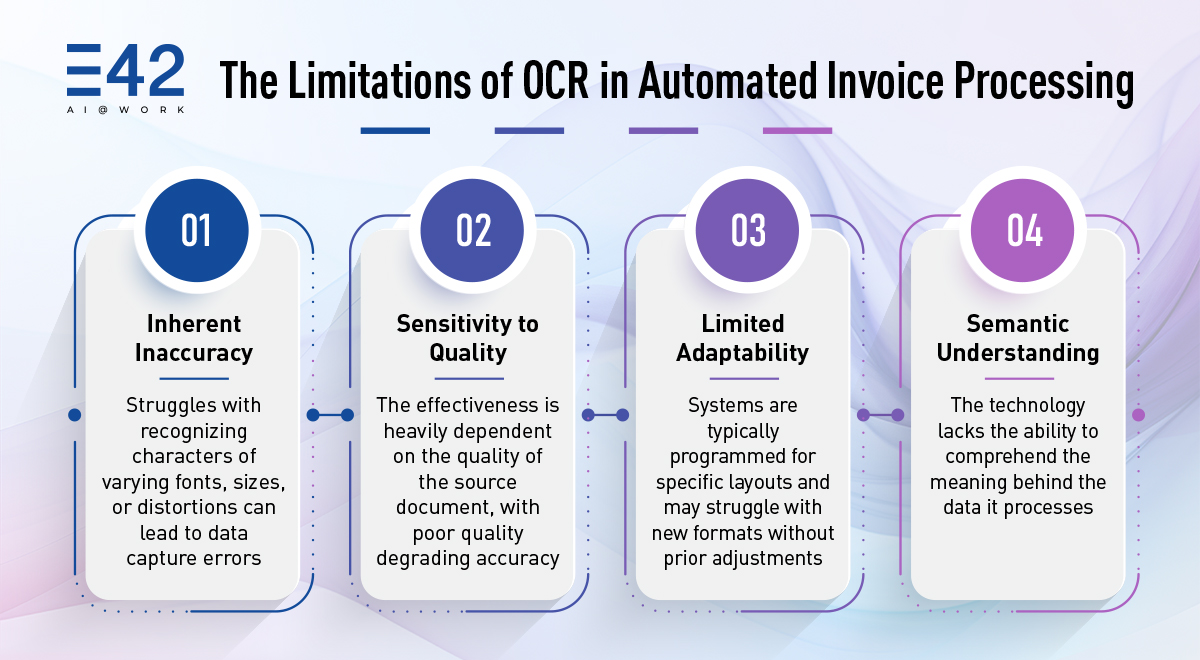
The Limitations of OCR in Automated Invoice Processing
OCR technology has played a foundational role in digitizing invoices, but it has clear limitations. Accuracy depends heavily on document quality and predefined templates. OCR cannot understand the meaning of extracted data or validate it in a business context.
This lack of semantic understanding leads to frequent errors, manual corrections, and exception handling. While OCR can reduce manual typing, it does not deliver the intelligence required for true end-to-end AP automation.
The advanced accounts payable automation solutions move beyond OCR toward intelligent, context-aware document processing.
The Evolution Towords AI Accounts Payable Automation
Modern finance operations require more than automation; they require intelligence. This has led to the introduction of Neil, our AI accounts payable automation solution.
Unlike traditional tools, intelligent AP automation systems can understand invoice context, learn from historical data, and continuously improve accuracy over time. They adapt to new invoice formats, handle complex exceptions, and support human decision-making rather than replacing it.
This shift marks a fundamental change in how the best accounts payable automation solutions are defined.
Why is E42’s Neil the Best Accounts Payable Automation Solution?
Neil, an AI-coworker for Accounts Payable represents the next generation of accounts payable automation. Built on Cognitive Process Automation and enhanced with generative AI and on-premises LLMs, Neil goes beyond simple automation, mimicking human intelligence to tackle complex tasks and continuously improving its capabilities. Here’s how Neil stands out as the best Accounts Payable automation solution:
- Understanding, not just mimicking: Accounts Payable process automation can interpret invoice content, like line items and context, using machine learning capabilities and generative AI. It allows different parsing methods for various invoice formats, ensuring exceptional adaptability. Additionally, on-premises LLMs provide unparalleled processing power to handle even the most complex invoice structures. Unlike cloud-based solutions, on-premises LLMs offer greater security and control over your sensitive financial data.
- Self-learning and adaptation: Automating Accounts Payable requires continuous learning from experience, improving data extraction accuracy and adapting to new invoice formats and scenarios. On-premises LLMs further accelerate this process of automated Accounts Payable by analyzing vast amounts of invoice data stored securely on your own infrastructure to continuously refine data extraction techniques.
- End-to-End Automation with a Human in the Loop: Neil automates the entire AP process, from invoice capture and data extraction to approval workflows and payment processing, seamlessly ensuring human review for complex exceptions or approvals, ensuring both efficiency and accuracy.
Advanced ICR: Surpassing OCR Limitations in AP Automation
While OCR technology often struggles with less-than-ideal scans and non-standard formats, Intelligent Character Recognition (ICR) technology transcends these challenges. Our ICR not only captures data from diverse document types with higher accuracy but also learns from its interactions, continuously improving its ability to recognize and process information from invoices, even when dealing with cursive handwriting or new layouts. This is how Neil, our accounts payable automation solution, elevates the AP process with advanced ICR capabilities, offering a refined solution. Beyond OCR, ICR analyzes the context of the invoice including layouts, terminology, and invoice structures, allowing Neil to handle variations like customized templates or foreign languages with utmost accuracy.
Real-Time Analysis and a Healthier Financial System with E42
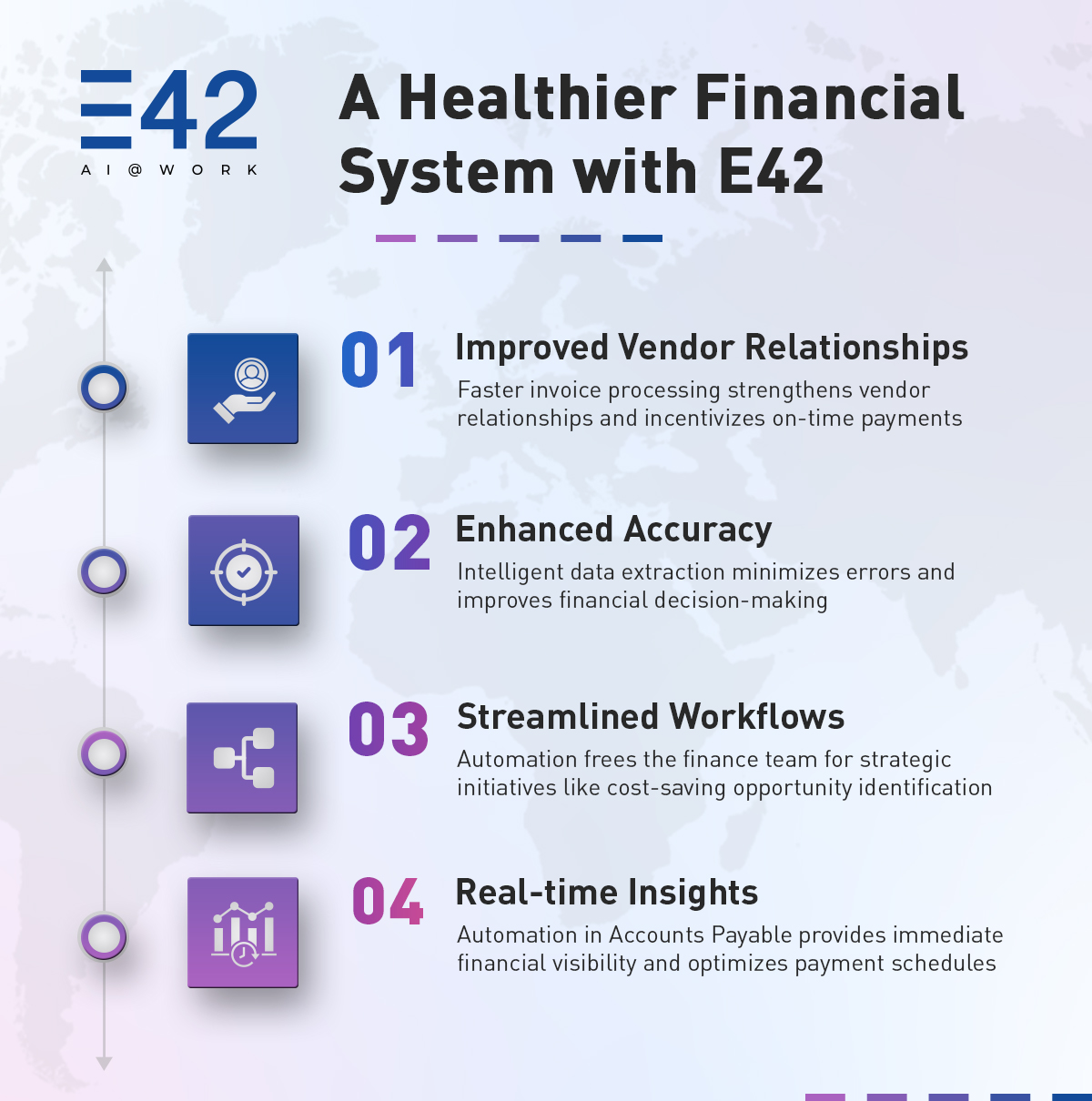
Neil brings a new level of efficiency and accuracy to your financial operations by streamlining your back-office tasks, provide real-time insights into your financial obligations, and improve vendor relationships. Here’s how:
- Real-time Insights: Automating Accounts Payable helps gain immediate visibility into your financial obligations, allowing for better cash flow management and informed decision-making. You can identify early payment discounts and optimize your payment schedules to maximize financial benefits.
- Enhanced Accuracy: Minimized errors with intelligent data extraction, reducing rework and improving financial recordkeeping. Accurate data is crucial for generating reliable reports and making sound financial decisions.
- Streamlined Workflows: Automated manual tasks like data entry, invoice routing, and approval workflows free up your finance team to focus on more strategic initiatives, like analyzing spending patterns and identifying cost-saving opportunities.
- Improved Vendor Relationships: Faster invoice processing ensures timely payments, strengthening relationships with your vendors. Additionally, E42 can automate early payment discounts, further incentivizing on-time payments and improving vendor satisfaction.
Neil empowers you to capitalize on vendor discounts with early payments. With real-time invoice processing and automated payment scheduling, you can identify and take advantage of early payment opportunities you might have missed with manual processes. This translates to significant cost savings and a strong return on investment.
What Key Performance Indicators (KPIs) to Consider when Choosing the Best Accounts Payable Automation Solution?
When evaluating Accounts Payable automation solutions, go beyond basic features and focus on measurable benefits. Here are some key performance indicators (KPIs) to consider:
- Invoice processing time: Measure the time it takes to process an invoice from receipt to payment. E42’s CPA significantly reduces processing times compared to manual or RPA-based solutions.
- Data extraction accuracy: Track the accuracy of data extracted from invoices. E42’s ICR technology ensures superior accuracy, minimizing errors and rework.
- Straight-through processing (STP) rate: Measure the percentage of invoices processed automatically without human intervention. E42’s CPA strives for a high STP rate, maximizing efficiency.
- Return on investment (ROI): Evaluate the cost savings and efficiency gains achieved compared to the investment in the Accounts Payable automation solution. E42’s automation delivers a strong ROI through reduced costs, improved accuracy, and faster processing times.
In conclusion, Neil, an AI Accounts Payable Executive built on E42 is not just a tool, but a transformative shift in how businesses manage their back-office operations. By harnessing the power of generative AI, on-premises LLMs, and advanced ICR, Neil is setting a new standard for AP automation. This is the future of back-office operations—a future where automation, accuracy, and adaptability are not just goals, but the norm. To experience the best Accounts Payable automation software out there, get in touch with us at interact@e42.ai.
Frequently Asked Questions
The best accounts payable automation solutions use AI and cognitive automation to deliver end-to-end AP processing with high accuracy and minimal manual intervention.
Traditional tools focus on isolated tasks and lack true understanding, adaptability, or learning capability. Modern solutions like Neil use Intelligent Character Recognition (ICR), machine learning, and cognitive automation to handle complexity and exceptions with minimal human intervention
Neil goes beyond task automation. It captures invoices from omni-channels, integrates with 20+ ERPs, applies n-way matching and business rules, and continuously improves accuracy using AI, making it one of the best accounts payable automation solutions for enterprises.
Neil combines multi-modal ICR, AI workflows, contextual validation, exception management, and real-time vendor communication — delivering high STP, deep ERP integration, and real business impact like fewer errors, faster processing, and cost savings
Absolutely. Neil supports configurable workflows, n-way validation, compliance checks, ERP integrations like SAP/Oracle/NetSuite, security-first deployment, and dashboard insights — capabilities expected from the best accounts payable automation solutions.
Neil can go live within one to two weeks, with seamless integration, minimal IT dependency, and flexible deployment options (cloud or on-premises) that suit enterprise environments.
Businesses report faster processing cycles, higher accuracy, reduced manual labor, improved vendor relationships, greater compliance, and accelerated ROI, making Neil one of the best accounts payable automation solution.