For most enterprises, the manual accounts payable process operates at a structural disadvantage. Teams are processing high volumes of invoices across multiple formats, coordinating approvals across departments, and managing vendor relationships, largely through manual intervention. The result is a function that is simultaneously over-burdened and under-optimised.
The consequences are well-documented: elevated processing costs, delayed payment cycles, compliance vulnerabilities, and limited financial visibility. Yet for many organisations, this remains the default operating model, not because better alternatives don’t exist, but because the path to Accounts Payable automation has historically appeared complex and disruptive.
This article examines the specific limitations of manual accounts payable processes, the measurable value that AP automation delivers, and a structured approach to implementation, including how AI co-workers are redefining what is operationally possible within the AP function.
What is Accounts Payable Process?
Before evaluating where manual processes fall short, it is useful to establish what the AP function actually encompasses. In a typical enterprise environment, the AP cycle involves the following stages:
- Purchase Order (PO) Creation: Formalising the terms of a procurement vendor, quantity, unit price, delivery date, and any applicable conditions.
- Goods Receipt Note (GRN) Generation: Confirming that ordered goods or services have been received in the agreed condition and quantity.
- Three-Way Matching: Reconciling the PO, GRN, and supplier invoice to verify alignment before authorising payment.
- Approval Workflows: Routing invoices through the appropriate stakeholders based on value thresholds, cost centre ownership, or organisational policy.
- Payment Processing: Executing payment within the agreed terms and ensuring accurate general ledger (GL) coding.
- Record-Keeping and Audit Compliance: Maintaining complete, traceable documentation for every transaction to satisfy internal controls and regulatory requirements.
What are the Challenges and Limitations of Manual Accounts Payable Process?
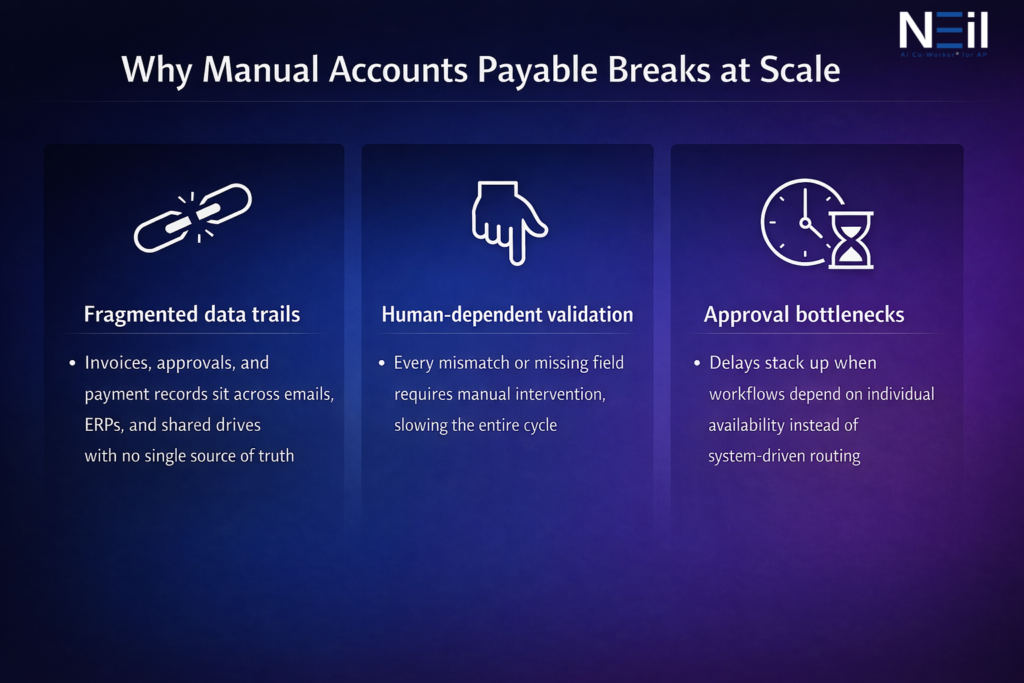
Manual AP processes introduce risk and inefficiency at multiple points in the transaction lifecycle. The following challenges are among the most commonly encountered and the most consequential.
Fraud Exposure and Inadequate Document Verification
Without automated validation mechanisms, AP teams have limited ability to verify the authenticity of invoices, detect forged signatures, or identify anomalous payment instructions. Manual review, however diligent, cannot match the consistency or scale of AI-driven verification. The financial and reputational consequences of AP fraud are severe, industry data suggests a median loss of $145,000 per incident, with many cases remaining undetected for extended periods.
Absence of a Consolidated Payment Record
In manual environments, payment history is often distributed across disparate system, email archives, shared drives, accounting software, and physical records. This fragmentation makes it difficult to maintain an accurate, up-to-date view of outstanding liabilities, creates conditions for duplicate payments, and complicates reconciliation at month-end.
Unstructured, Multi-Format Invoice Intake
Suppliers submit invoices through a variety of channels and in a range of formats, paper documents, scanned PDFs, email attachments, and more. Each format requires separate handling, and the data within each invoice must be manually interpreted and entered into the accounting system. This introduces both inefficiency and error, particularly at volume.
Operational Overload and Resource Misallocation
Research consistently indicates that AP teams in manual environments spend most of their time on transactional, low-value tasks. This leaves limited capacity for analysis, process improvement, or strategic financial planning. The consequence is a function that operates well below its potential contribution to the business, while simultaneously experiencing high levels of staff attrition driven by repetitive, low-autonomy work.
Approval Bottlenecks and Extended Processing Cycles
Manual approval workflows are inherently dependent on individual availability. Invoices awaiting authorisation can sit unprocessed for days when approvers are unavailable, when escalation paths are unclear, or when supporting documentation is incomplete. There is no built-in mechanism for automatic escalation, real-time status tracking, or SLA enforcement. The result is extended payment cycles that strain vendor relationships and, in some cases, trigger late payment penalties.
Audit and Compliance Risk
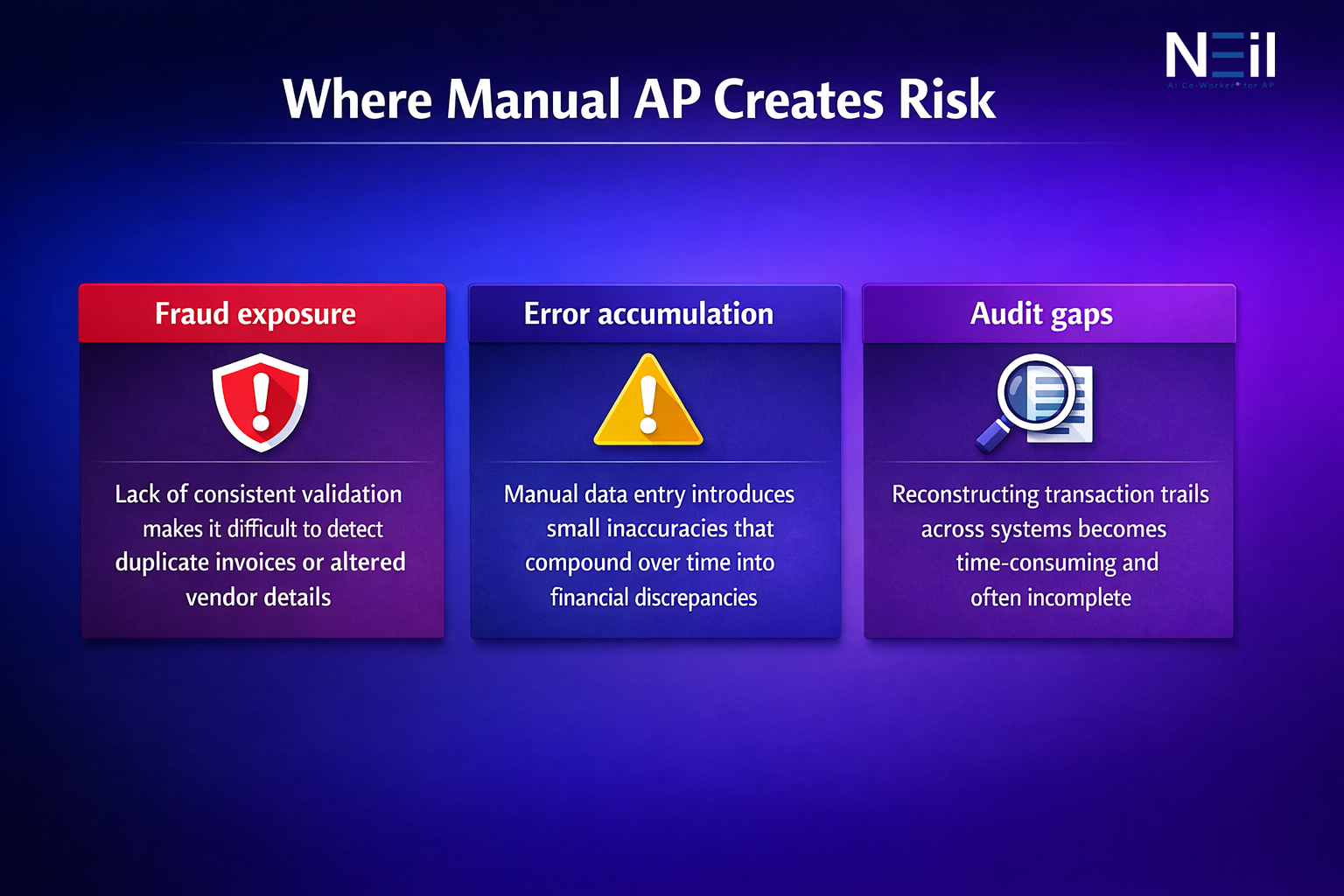
Regulatory frameworks such as GDPR and SOC2, along with internal audit requirements, demand complete and verifiable transaction records. Reconstructing an audit trail from manual records across multiple systems, document types, and approval channels is a time-intensive process that is prone to gaps. In the event of an audit, these gaps can result in findings, remediation costs, and reputational exposure.
How Accounts Payable Automation Addresses Manual AP Challenges?
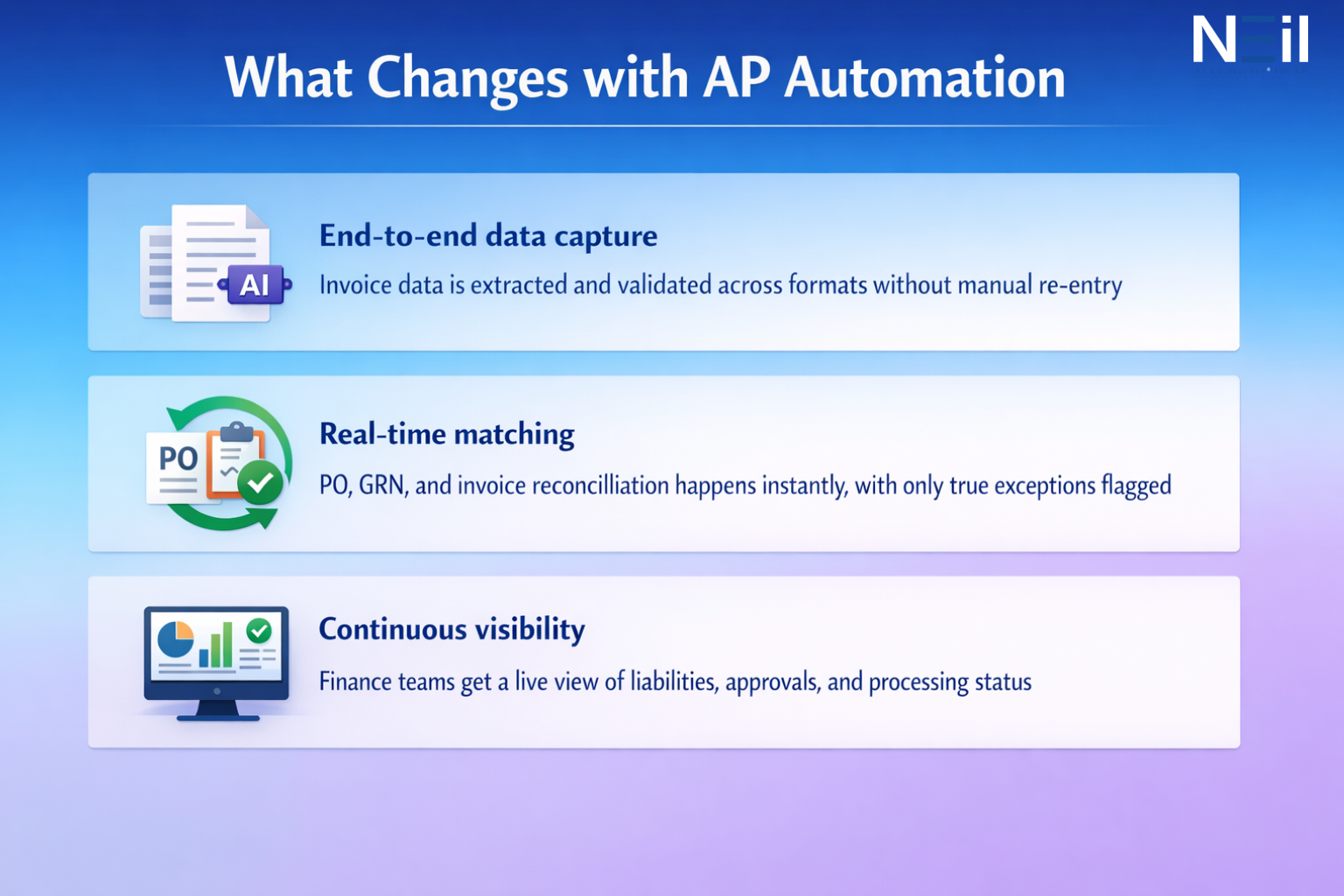
Accounts Payable Automation addresses the limitations of manual AP not through incremental improvement, but through structural redesign of how the function operates. The benefits are measurable, well-evidenced, and cumulative.
Accurate, High-Volume Data Extraction
Intelligent Document Processing (IDP) combining Intelligent Character Recognition (ICR) with Natural Language Processing (NLP) enables automated extraction of invoice data regardless of format or source. Structured and unstructured data alike can be captured accurately, at scale, without manual intervention. This eliminates the primary source of data entry errors and dramatically reduces processing time.
Automated Three-Way Matching
Automated systems perform PO-GRN-invoice matching in real time, flagging discrepancies for human review rather than requiring manual comparison across multiple documents and systems. This accelerates the approval process, reduces the risk of erroneous payments, and ensures that exceptions not routine transactions are what demand AP team attention.
Proactive Fraud Detection
AI-driven AP systems continuously analyse transaction data for anomalies: duplicate invoice submissions, alterations to vendor banking details, invoices from unverified suppliers, and signature irregularities. These signals are identified and escalated before payment is released, rather than discovered after the fact during a reconciliation or audit.
Structured, Trackable Approval Workflows
Automated workflows route invoices to the appropriate approvers based on configurable rules, enforce SLA timelines, and escalate automatically when thresholds are exceeded. Every action is logged with a timestamp and user record, creating a complete and auditable approval history without any additional administrative effort.
Real-Time Financial Visibility
Automated Accounts Payable solutions provide continuous visibility into outstanding payables, payment obligations, and processing performance. Finance leadership can access accurate, current data for cash flow forecasting, accrual management, and strategic decision-making — without waiting for month-end consolidation.
Compliance and Audit Readiness
Every transaction processed through an automated AP system is accompanied by a complete, immutable audit trail. Document storage, approval records, and processing logs are maintained systematically and are immediately retrievable. This significantly reduces the effort and risk associated with internal audits, external reviews, and regulatory compliance requirements.
Role of Neil: An AI Co-Worker in Solving Manual Accounts Payable Challenges
Neil, an AI co-worker for AP designed specifically to manage the accounts payable function not as a peripheral tool, but as an active participant in the AP process. Operating across the full transaction lifecycle, Neil handles the operational work of AP with the consistency, accuracy, and auditability that manual processes cannot reliably deliver.
Neil’s core capabilities include:
- Invoice Ingestion and Data Extraction: It captures and extracts structured data from invoices in any format like paper, PDF, email attachment, or vendor portal with high accuracy and without manual input.
- Automated Three-Way Matching: It performs real-time matching of purchase orders, goods receipt notes, and supplier invoices, flagging exceptions for human review and approving matched invoices for payment processing.
- Digital Signature Validation: It verifies the authenticity of digital signatures on incoming documents, reducing fraud exposure without introducing additional manual review requirements.
- GL Code Mapping: It automatically assigns the appropriate general ledger codes to each transaction, eliminating one of the most error-prone aspects of manual AP processing.
- Vendor Communication Management: Neil handles routine vendor communication such as payment status enquiries, document requests, discrepancy notifications — reducing the volume of vendor queries that reach the AP team.
- Real-Time Reporting and Analytics: Neil provides finance leadership with continuous visibility into AP performance metrics, outstanding payables, processing cycle times, and exception rates.
What are the Best Practices to Implement Accounts Payable Automation?
A successful Accounts Payable (AP) automation deployment requires deliberate planning, phased execution, and sustained organisational commitment. The following framework reflects best practice across enterprise implementations.
- Conduct a Comprehensive Process Audit, identify where delays, errors, and manual effort are most concentrated.
- Establish specific, quantitative targets before implementation begins such as target cost per invoice, processing cycle time, error rate, early payment discount capture rate, and audit compliance metrics.
- Evaluate AP automation solutions against your defined requirements, with particular attention to IDP capabilities, ERP integration depth, security and compliance posture (GDPR, SOC2), and configurability.
- Deploy the automated process on a representative subset of invoice types and volumes before full rollout.
- Provide structured training for AP team members, with clear guidance on exception handling, escalation paths, and system use.
- Define a regular cadence for reviewing AP performance metrics, identifying optimisation opportunities, and updating automation rules to reflect process or policy changes.
Conclusion
Manual accounts payable processes introduce a set of operational, financial, and compliance risks that become increasingly difficult to manage as transaction volumes grow. The limitations are not incidental, they are structural, and they do not resolve themselves through incremental process improvement.
Accounts payable automation, delivered through platforms capable of intelligent document processing, automated matching, and real-time analytics, addresses these limitations at their root.
The result is a function that operates with greater accuracy, lower cost, and stronger compliance posture, while enabling AP teams to redirect their expertise toward higher-value financial work.
AI co-workers such as Neil represent the next stage of this evolution: not automation as a set of discrete tools, but as a capable, autonomous participant in the AP process, one that operates consistently, scales with the business, and delivers measurable outcomes from deployment.
To learn more about Neil and AP automation, visit Neil or get in touch with us at interact@e42.ai
FAQs
Accounts payable automation uses AI, ICR, and NLP to streamline the entire AP process right from invoice capture and data extraction to approvals and payments, reducing manual effort and improving accuracy.
The most significant limitations include elevated per-invoice processing costs, extended approval and payment cycles, high susceptibility to data entry errors, limited fraud detection capability, lack of real-time financial visibility, and substantial compliance and audit risk.
AI improves accuracy in data extraction, detects anomalies for fraud prevention, automates approval workflows, and provides real-time insights, helping reduce processing time, errors, and operational costs.
Three-way matching is the process of reconciling a supplier invoice against the corresponding purchase order and goods receipt note prior to authorising payment. In automated AP environments, this reconciliation is performed in real time, with discrepancies flagged for human review rather than requiring manual comparison across documents.
At a minimum, solutions should demonstrate compliance with GDPR for data privacy and SOC2 for security controls. Robust AP automation platforms also maintain complete, immutable audit trails for every transaction, supporting both internal audit requirements and external regulatory review.
Common indicators include long invoice processing times, frequent errors or duplicate payments, AP team consistently working beyond normal capacity, inability to capture early payment discounts, and insufficient audit trail documentation.
Automated AP systems apply consistent validation rules to every transaction, identifying anomalies that manual review would frequently miss including duplicate invoice submissions, changes to vendor banking details, invoices from unverified counterparties, and signature irregularities.