The role of the CFO has evolved dramatically over the past decade. No longer confined to the traditional responsibilities of financial reporting and compliance, today’s CFOs have emerged as architects of organizational change and strategic transformation leaders. This shift reflects a broader recognition that finance transformation is not merely a departmental upgrade.
As businesses face mounting pressure to operate with greater agility, transparency, and efficiency, CFO finance transformation has become central to enterprise success. Modern CFOs are expected to leverage technology, harness data analytics, and reimagine finance operating models to drive value across the entire organization. This evolution from financial controller to transformation champion represents one of the most significant shifts in executive leadership in recent memory.
What Is Finance Transformation?
Finance transformation refers to the comprehensive reimagining of how finance functions operate, deliver value, and support strategic decision-making across an enterprise. It encompasses process redesign, technology adoption, organizational restructuring, and cultural change, all aimed at creating a more agile, data-driven, and strategic finance function.
While often conflated with digital transformation, finance transformation is distinctly broader in scope. Digital transformation typically focuses on implementing new technologies to improve existing processes. Finance transformation, by contrast, fundamentally rethinks the role of finance within the organization. It asks critical questions: How should finance allocate its time? What value should it deliver beyond compliance? How can finance become a driver of competitive advantage rather than merely a recorder of historical performance?
Finance sits at the core of enterprise change because it touches every aspect of business operations—from strategic planning and resource allocation to risk management and performance measurement. When finance transforms, it creates ripple effects throughout the organization, enabling better decisions, faster responses to market changes, and more effective resource deployment.
How are the CFO Expanding their Role in Finance Transformation
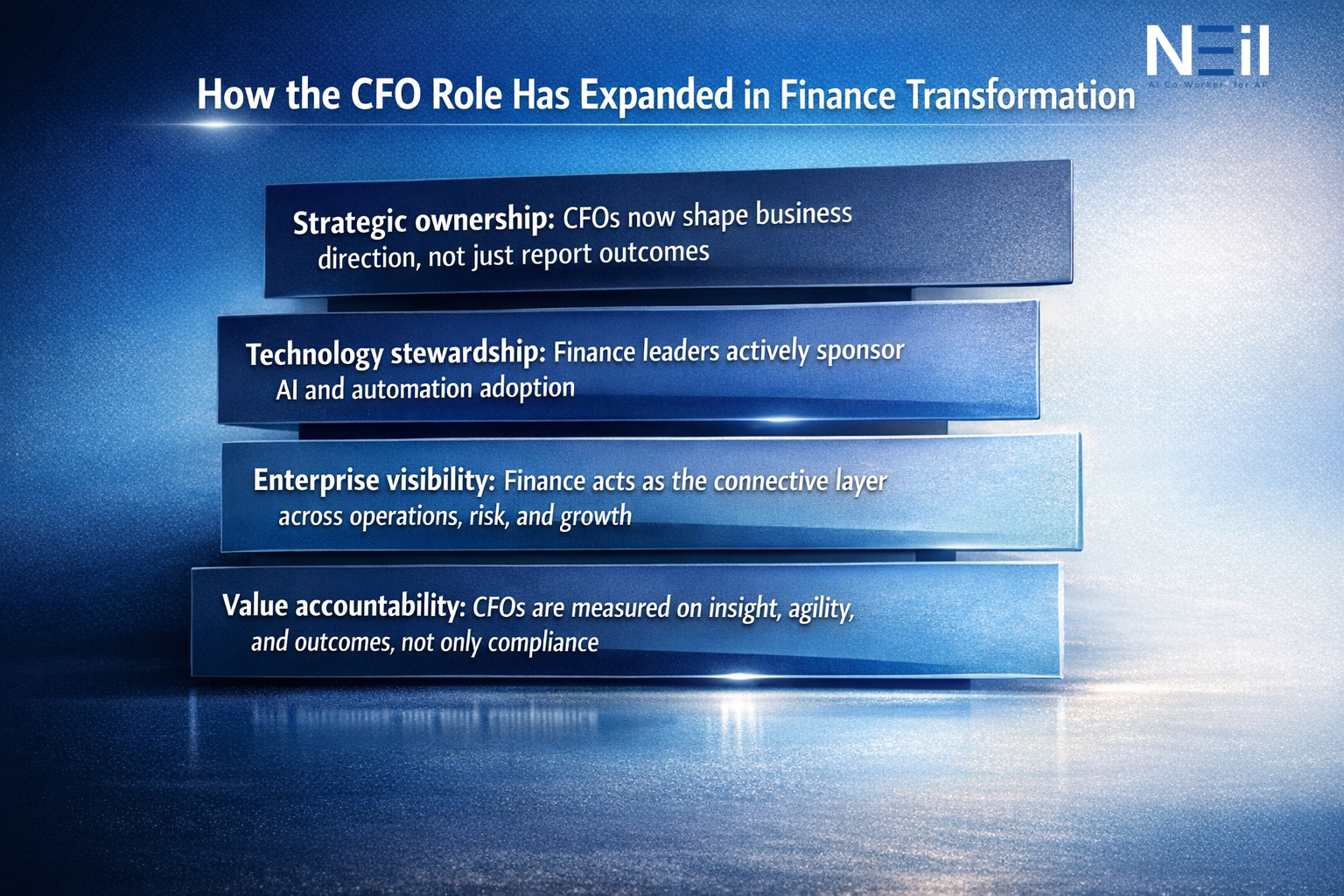
The modern CFO has evolved into a strategic and technology-driven leader who bridges the gap between finance, operations, and innovation. This expanded role requires CFOs to think beyond traditional financial metrics and embrace a broader mandate that includes driving organizational transformation.
Automating Core Financial Processes
Technologies such as AI, Cognitive Process Automation (CPA), and intelligent automation are revolutionizing how finance operations handle routine tasks like invoice processing, expense management, and financial close activities.
By automating repetitive, manual tasks, CFOs can dramatically reduce processing times, minimize human error, and free their teams to focus on higher-value analytical work. Organizations implementing intelligent automation in accounts payable, for instance, have reported processing time reductions of up to 80% and accuracy improvements that virtually eliminate payment errors. This shift from manual data entry to automated workflows represents a fundamental change in how finance delivers value.
Data-Driven Finance Leadership
CFOs now have access to sophisticated analytics platforms that can identify trends, forecast outcomes, and simulate scenarios with unprecedented accuracy. This capability enables smarter decision-making across the enterprise, as finance leaders can provide actionable insights on everything from pricing strategies and market expansion to operational efficiency and capital allocation. The role of CFOs has expanded to include serving as the organization’s chief data interpreter, translating complex financial information into strategic imperatives.
Reimagining Finance Operating Models
Finance transformation requires fundamentally rethinking how finance organizations are structured and what they prioritize. The shift is from transactional finance to value-driven finance that actively shapes business strategy.
This transition involves restructuring finance teams around business partnering rather than functional silos, investing in talent with both financial and analytical capabilities, and establishing service delivery models that balance efficiency with strategic impact. Progressive CFOs are creating tiered operating models where routine transactions are highly automated, allowing senior finance professionals to dedicate their expertise to strategic analysis, business partnering, and innovation initiatives.
Building an Agile and Resilient Finance Function
As orchestrators of finance transformation, CFOs must ensure their functions are not only efficient but also agile and resilient in the face of evolving challenges.
Reassessing Risk in a Digital World
The digital transformation of finance introduces new risk dimensions that CFOs must actively manage. Financial fraud has become a critical concern as finance systems hold sensitive financial data and payment credentials. Compliance requirements continue to multiply across jurisdictions, requiring sophisticated monitoring and control systems. Data governance has emerged as essential to ensuring that the insights driving decisions are based on accurate, consistent information.
CFOs must build comprehensive risk management frameworks that address these concerns while not impeding the speed and innovation that finance transformation aims to deliver. This balance requires investments in security infrastructure, clear policies around data access and usage, and continuous monitoring of both traditional financial risks and emerging technological vulnerabilities.
Scaling Finance Operations with Automation
A critical test of any finance transformation initiative is whether it creates scalable operations that can grow with the business without proportional increases in cost or complexity. Intelligent finance operations achieve this scalability through AP automation platforms that handle increasing transaction volumes without requiring additional headcount.
Cloud-based finance systems provide the infrastructure elasticity needed to support business expansion, while AI-powered tools can adapt to new transaction types, currencies, and regulatory requirements without extensive reprogramming. CFOs who successfully implement these scalable solutions position their organizations to pursue growth opportunities without being constrained by finance’s processing capacity.
Measuring Finance Transformation Success
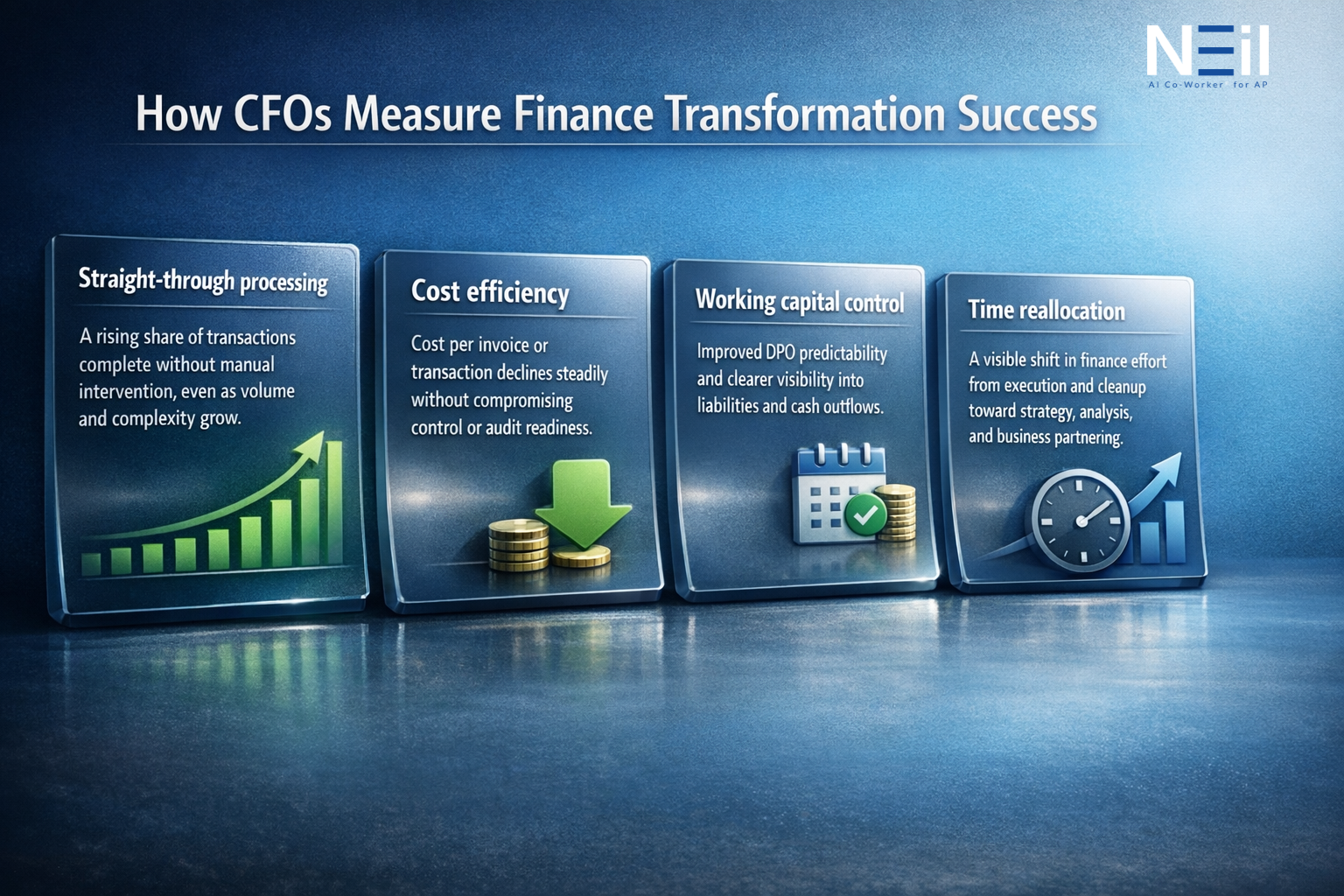
Effective CFOs establish clear metrics to measure progress and demonstrate the value of finance transformation initiatives. Key performance indicators might include straight-through processing (STP) rates that measure the percentage of transactions completed without manual intervention, cost-per-invoice or cost-per-transaction metrics that track operational efficiency, days sales outstanding (DSO) and days payable outstanding (DPO) that reflect working capital optimization, and the percentage of finance time spent on strategic versus transactional activities.
These metrics provide both accountability for transformation investments and visibility into where further improvements are needed. Progressive CFOs regularly share these metrics with boards and executive teams to maintain momentum and support for ongoing transformation efforts.
Accounts Payable Automation as a Pillar of Finance Transformation
Many successful finance transformation journeys begin with accounts payable automation. AP represents a high-impact starting point because it combines significant processing volumes with relatively straightforward automation opportunities and measurable business benefits.
Manual AP processes are typically characterized by paper-based workflows, multiple handoffs, and limited visibility into processing status. These inefficiencies create delays in payment processing, missed early payment discounts, strained supplier relationships, and elevated processing costs. By automating AP, CFOs can quickly demonstrate tangible results that build support for broader transformation initiatives.
Importantly, accounts payable automation requires strong CFO ownership to succeed. It touches multiple stakeholders including procurement, operations, and suppliers, making it inherently cross-functional. CFOs who personally champion AP automation send a clear signal about the strategic importance of finance transformation and their commitment to driving change.
How Neil, AI Co-Worker for AP Enable Finance Transformation
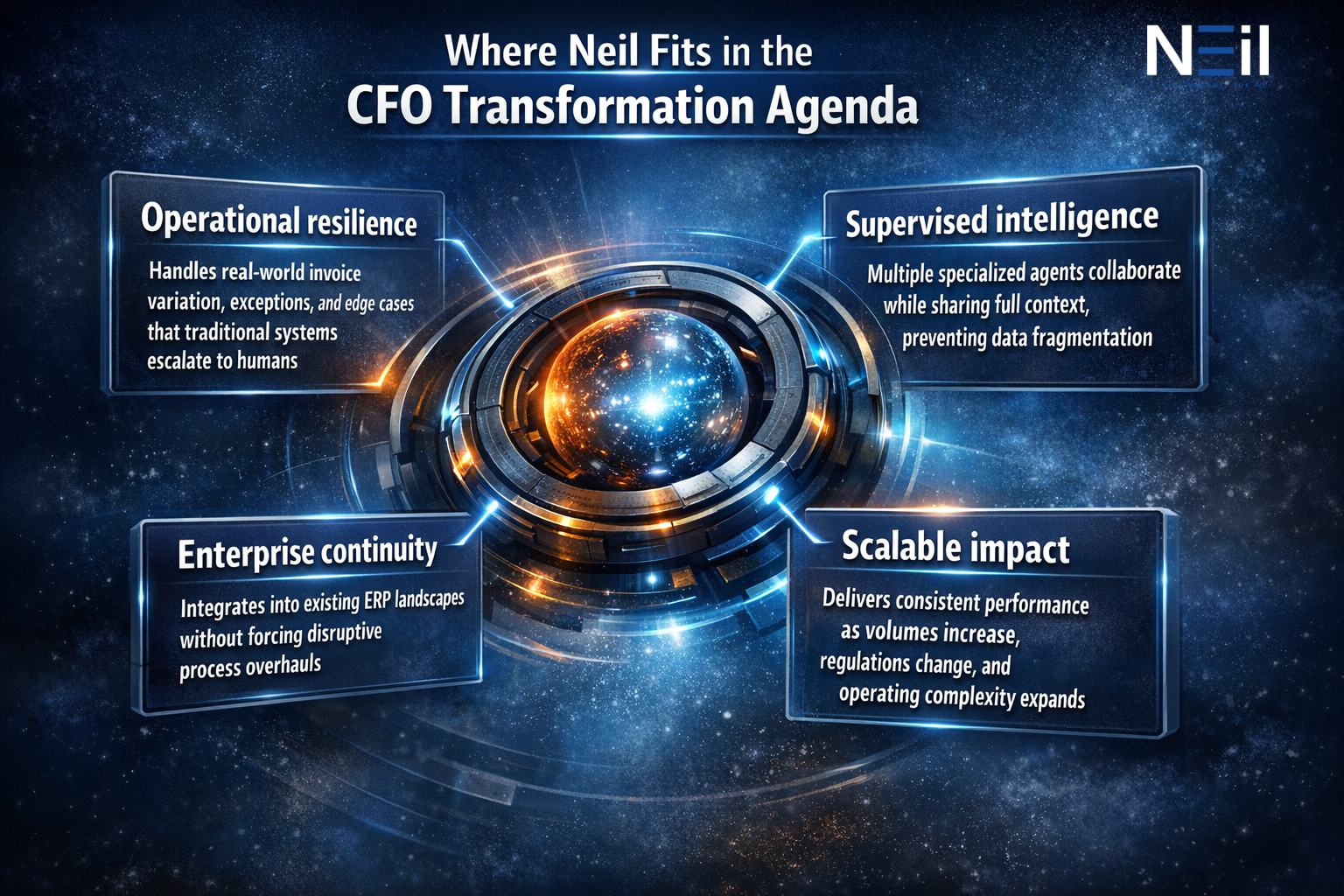
The emergence of Neil, our AI Co-Worker for AP represents a new approach to accounts payable automation that addresses the complexity characterizing real enterprise finance operations. Unlike traditional rule-based systems that struggle with exceptions, Neil handles the messy reality of varied invoice formats, multiple submission channels, and constant workflow changes.
Neil employs multi-agentic architecture where specialized AI agents collaborate on distinct process elements. Neil navigates month-end backlogs, vendor escalations, and handwritten invoices, scenarios where traditional automation typically requires human intervention. The AP automation solution achieves STP rates exceeding 90% with accuracy above 85%, performance levels that fundamentally reshape AP operations.
For CFOs leading finance transformation, these capabilities translate directly into measurable impact. Data ingestion that previously consumed two weeks completes in minutes. Teams gain conversational access to workflow information through natural language queries. Integration with major ERPs ensures compatibility with existing systems while delivering the scalability essential for growing organizations.
Conclusion
CFOs have emerged as architects of modern finance organizations, transforming their functions from tactical support into strategic business enablers. Finance transformation—encompassing technology, processes, structure, and talent—has become a competitive imperative in today’s dynamic business environment.
Successful CFO leadership begins with high-impact initiatives like accounts payable automation that deliver quick wins while building toward comprehensive transformation. Organizations with agile, data-driven, and automated finance functions respond faster to market changes and make better strategic decisions than competitors constrained by manual processes. CFOs who successfully lead finance transformation position their organizations to thrive amid constant disruption.
FAQs
Finance transformation modernizes finance functions through process redesign, technology adoption, and organizational change, enabling finance to move from transactional processing to strategic value creation and competitive advantage.
CFOs lead by setting strategic vision, championing technology investments, redesigning operating models, and measuring progress through clear KPIs while balancing quick wins with long-term transformation goals.
Digital transformation focuses on implementing new technologies to improve existing processes, while finance transformation fundamentally rethinks finance’s role within the organization through comprehensive change.
AI enables transformation through intelligent automation of routine tasks, predictive analytics for forward-looking decisions, and continuous learning that improves accuracy, allowing finance teams to focus on strategy.
AP automation delivers measurable ROI quickly, demonstrates automation value to stakeholders, and frees finance resources for higher-value activities, building momentum for broader transformation.
CFO leadership provides the strategic vision, executive sponsorship, and resource allocation needed to drive cross-functional coordination, cultural change, and sustained investment in automation.
Transformation improves agility through real-time data access and flexible planning, while enhancing scalability through cloud-based systems and intelligent automation that grows with the business.
Common challenges include change resistance, legacy system integration complexity, balancing transformation investment with operations, talent gaps, and maintaining business continuity during transition.
AI platforms accelerate ROI through rapid deployment, immediate processing improvements, scalability without future system replacements, and continuous learning that delivers increasing value over time.