
Finance functions have long operated under the weight of legacy processes whether it’s paper invoices, manual data entry, siloed approval chains, and reactive reporting. As businesses’ scale and financial complexity grow, these outdated ways of working are no longer sustainable. Accounts payable transformation is how leading organizations break free from these constraints and rebuild their AP function from the ground up.
Accounts payable transformation is more than just adopting new software. It is a fundamental rethinking of how AP operates—redesigning processes, upskilling teams, integrating intelligent technologies, and aligning the AP function with broader strategic finance goals. The result is a faster, smarter, and more resilient AP operation that creates measurable value across the organization.
This guide explains what accounts payable transformation means, why it matters, what it involves, and how your organization can lead a successful AP transformation journey.
What Is Accounts Payable Transformation?
Accounts payable transformation is the strategic overhaul of an organization’s AP function, encompassing process redesign, technology adoption, organizational change, and performance improvement. It goes beyond incremental efficiency gains to fundamentally change how the AP team captures, processes, approves, and pays invoices, and how it contributes to financial strategy.
A true AP transformation initiative typically combines intelligent automation, AI-powered data processing, ERP integration, and cultural change to eliminate manual work, reduce costs, and give finance leaders real-time visibility into cash flow and liabilities.
Where traditional Accounts payable improvement efforts focus on doing the same things faster, AP transformation focuses on doing things differently — replacing manual steps with intelligent workflows, reactive decision-making with predictive analytics, and fragmented systems with connected, end-to-end processes.
Why Accounts Payable Transformation Is a Business Imperative?
AP sits at the center of an organization’s financial operations, governing supplier payments, cash flow obligations, and financial record accuracy. When it works well, it supports strong vendor relationships, precise forecasting, and strategic cash management. When it doesn’t, the consequences ripple across the entire business.
Most AP functions face four major challenges:

Challenges in Manual Accounts Payable Processes
In today’s business landscape, many organizations continue to grapple with manual AP processes, which present a host of challenges. In this section, we will delve into the drawbacks of relying on manual AP processes, highlighting the need for automation to overcome these limitations.
- Vulnerability to Fraudulent Activities: Manual AP processes are more susceptible to fraudulent activities, including forged signatures and document authenticity issues. Without automation, it becomes challenging to detect and prevent these fraudulent attempts, potentially exposing the company to financial risks and reputation damage.
- Inefficient Data Handling: Manual processes often result in the loss of important data and physical documents like checks. This can lead to delays, financial risks, and hinder tracking and analysis of past transactions, impacting on the company’s financial stability.
- Decreased Efficiency and Increased Workload: Manual handling of invoices and payments can overwhelm AP teams, reducing their efficiency and productivity. This inefficiency not only slows down processes but also increases the risk of errors like data entry mistakes, delinquent payments, and missing invoices.
- Limited Real-Time Insights: Manual AP processes lack real-time data insights, making it challenging for AP teams to access up-to-date financial information. This limitation can affect decision-making and the ability to maintain strong relationships with vendors and suppliers while staying compliant.
In contrast, AI-led Accounts Payable automation solutions address these issues by enhancing accuracy, reducing the risk of fraud, improving efficiency, providing real-time data access, streamlining financial operations, and contributing to the company’s success.
Understanding the Accounts Payable Automation
Accounts Payable automation is a transformative approach that employs technology to streamline and automate the tasks involved in managing supplier invoices and payments. It is designed to enhance the efficiency of financial operations for businesses of all sizes.
The process involves efficient extraction of data from invoices and automating essential steps like n-way matching and General Ledger (GL) code mapping. This is achieved through the implementation of artificial intelligence (AI) and Cognitive Process Automation (CPA), which plays a significant role in reducing operational costs for enterprises.
Benefits of Accounts Payable Automation
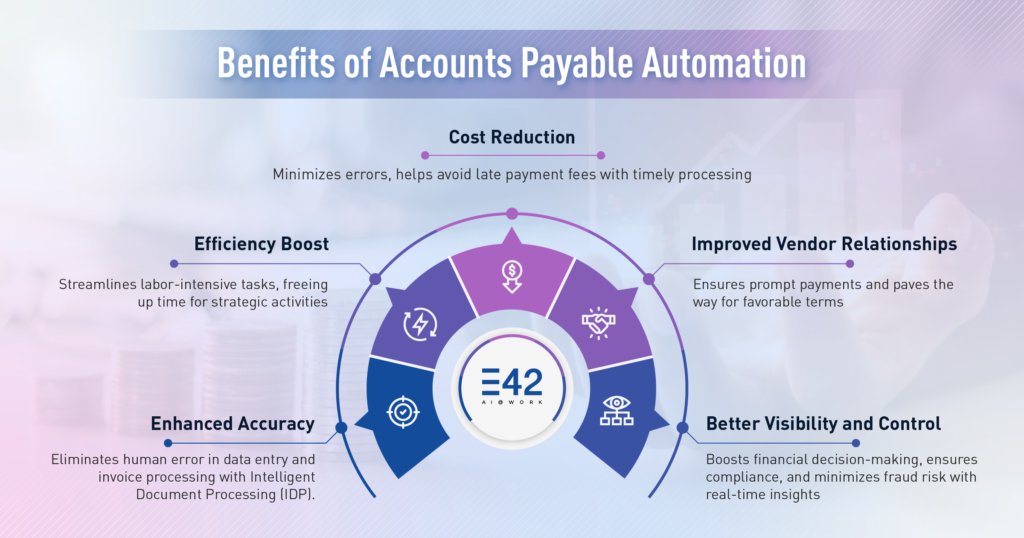
CPA-powered Accounts Payable (AP) automation brings many benefits to businesses, enhancing efficiency and accuracy while reducing costs. Here is a brief overview:
- Enhanced Accuracy: One of the primary advantages of AP automation is improved accuracy. Manual data entry and invoice processing are prone to human errors, which can be costly and time-consuming to rectify. With invoice processing automation, the risk of errors is significantly reduced, leading to more accurate financial records.
- Efficiency Boost: Manual AP processes can be labor-intensive, requiring employees to spend valuable time on tasks like data entry and invoice matching. AP automation streamlines these processes, freeing up time to focus on more strategic activities.
- Cost Reduction: By reducing the need for manual labor and minimizing errors, AP automation can lead to substantial cost savings. It can also help enterprises avoid late payment fees by ensuring that invoices are processed and paid on time.
- Improved Vendor Relationships: Prompt and accurate payments with AP automation allows businesses to pay invoices promptly, strengthening vendor relationships and potentially leading to favorable terms and discounts.
- Greater Visibility and Control: AP automation empowers organizations to make informed financial decisions while minimizing the risk of costly mistakes or fraud by providing real-time insights into financial obligations. This reduces errors and ensures compliance with company policies and regulations.
Getting Started with AP Automation
Here are the key steps to effectively implement AP automation:
- Evaluate current AP processes and set clear goals: Analyzing existing operations, identifying bottlenecks like manual data entry, and establishing objectives for faster and more accurate invoice processing automation.
- Choose the right AP automation tools: Selecting solutions designed for AP workflows, featuring intelligent document processing and seamless integration with existing systems.
- Use data analytics for AP performance: Implementing real-time reporting to pinpoint trends and enhance cash flow management.
- Prioritize data security: Ensuring robust encryption, access controls, and compliance with data protection regulations.
- Streamline AP and AR with smart document processing: Utilizing NLP for automated data capture and validation, expediting invoice processing.
- Follow a structured implementation process: Planning systematically, assessing needs, choosing the ideal solution, customizing, and providing comprehensive team training.
- Stick to best practices: Engaging stakeholders, maintaining data quality, executing thorough testing, and continuously monitoring and enhancing AP automation for sustained success.
Conclusion
The strategic adoption of Accounts Payable automation is a crucial step for businesses seeking to improve the efficiency, accuracy, and competitiveness of their financial operations. By implementing AP automation solutions, organizations can revolutionize their financial processes, automate manual tasks, gain insightful data, and streamline workflows. Essentially, enterprises should automate Accounts Payable processes to enable a data-centric approach that promotes informed decision-making and exponential business growth in the ever-evolving world of modern finance.
Streamline Your Finance Operations with E42
E42 is a no-code Cognitive Process Automation (CPA) platform to build AI co-workers that automate business processes across functions with high speed and accuracy. Tailored for the finance domain, the AI co-workers built on E42 excel in handling crucial tasks like Accounts Payable, Accounts Receivable, and financial reporting thus serving as the perfect Accounts Payable automation solution. Operating at an accelerated rate, these AI co-workers offer end-to-end process automation, benefiting both the finance team and the overall business. To automate your Accounts Payable process, get in touch with us at interact@e42.ai.