In accounts payable, precision is everything. A single miskeyed invoice number, a missing vendor field, or a duplicated payment can cascade into financial losses, compliance headaches, and eroded supplier relationships. Invoice data validation is the systematic process of verifying that incoming invoice data is complete, accurate, and consistent with business rules — is not a nice-to-have; it is the cornerstone of a healthy AP process.
At its core, AP data validation ensures that every invoice entering the payable workflow meets predefined standards before human eyes ever review it. Done well, it eliminates costly errors before they become problems, enforces financial controls automatically, and dramatically reduces the manual workload that bogs down AP teams.
Neil, our AI Co-Worker for Accounts Payable is built from the ground up to address exactly this challenge. As an intelligent accounts payable automation platform, Neil applies a multi-layered approach to AP data validation techniques — combining structured business rules, machine learning, and continuous feedback loops to achieve near-zero-touch invoice processing. Throughout this guide, Neil serves as the central example of how advanced validation strategies translate into real-world AP efficiency.
Understanding Data Validation in Accounts Payable
Invoice data validation is the process of checking that every data point captured from an incoming invoice — vendor name, invoice number, line-item amounts, tax codes, purchase order references, payment terms — conforms to expected formats, business rules, and master data records. It happens at multiple stages of the AP workflow: at the point of data capture, during matching, and before payment release.
Common Validation Challenges
AP teams contend with a persistent set of data quality problems that manual processes struggle to catch consistently:
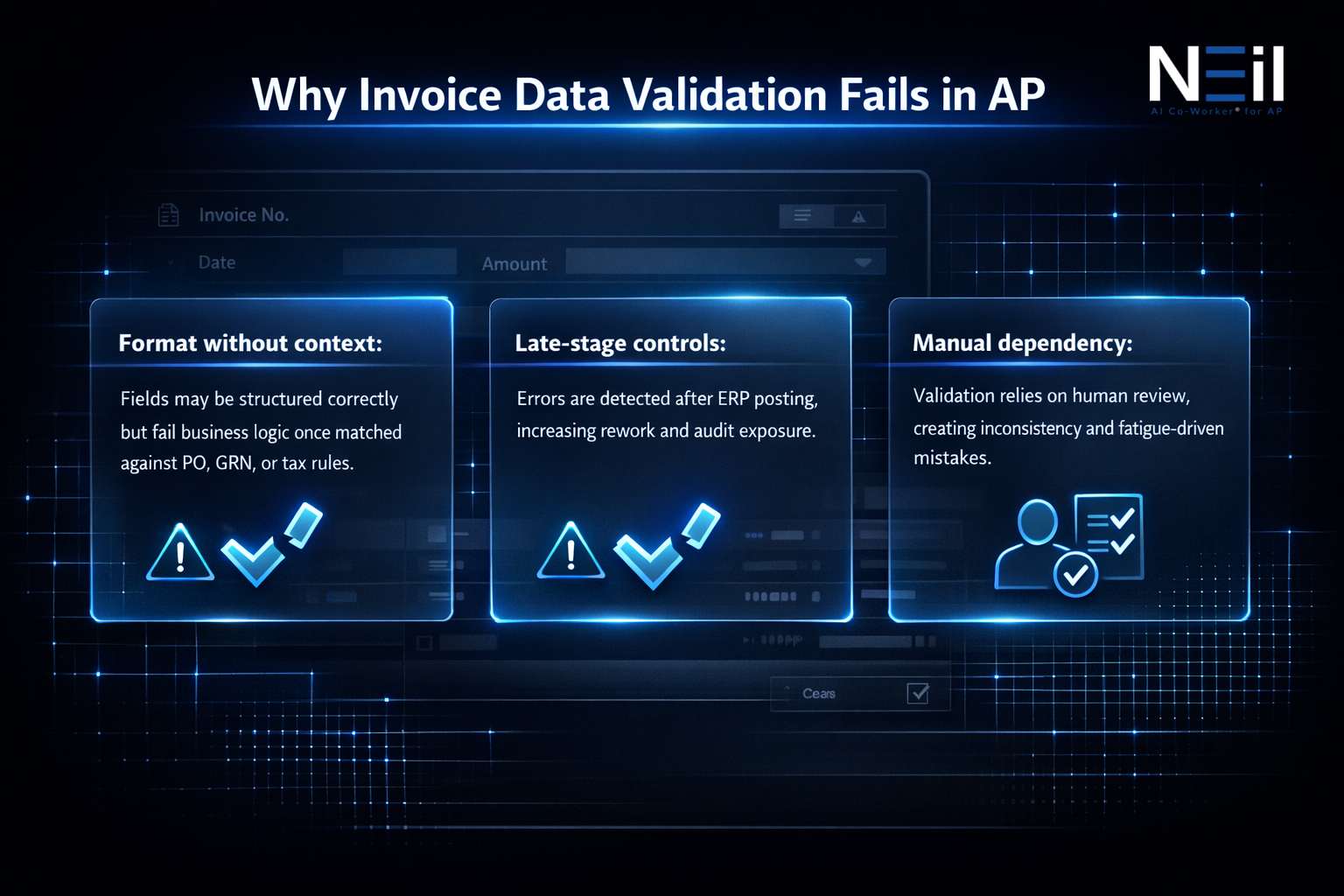
- Missing mandatory fields such as invoice date, vendor tax ID, or remittance address.
- Incorrect formats — dates entered as text strings, numeric amounts containing currency symbols, or PO numbers mismatched against the expected pattern.
- Duplicate invoices submitted by vendors, either accidentally or as part of fraudulent schemes, resulting in overpayments.
- Arithmetic errors where line-item subtotals do not reconcile with the invoice total or tax calculations are applied at the wrong rate.
- Mismatches between invoice data and purchase orders or receiving records that signal unauthorized spend or pricing discrepancies.
How Poor Validation Increases Risk and Manual Effort
When invoice data validation is absent or inconsistent, the consequences extend well beyond a few correctable mistakes. Duplicate payments drain cash; errors that reach the ERP require expensive rework; exceptions pile up in queues, extending payment cycle times and threatening early-payment discount capture. Regulatory audits become painful when invoice records are incomplete or inconsistent. And the reputational cost with suppliers — delayed payments, disputes, and strained relationships — compounds over time.
Robust AP automation solution eliminates most of these risks at source, keeping the invoice pipeline clean, fast, and auditable.
What are Some of the Advanced Data Validation Techniques?
Field-Level & Format Validation
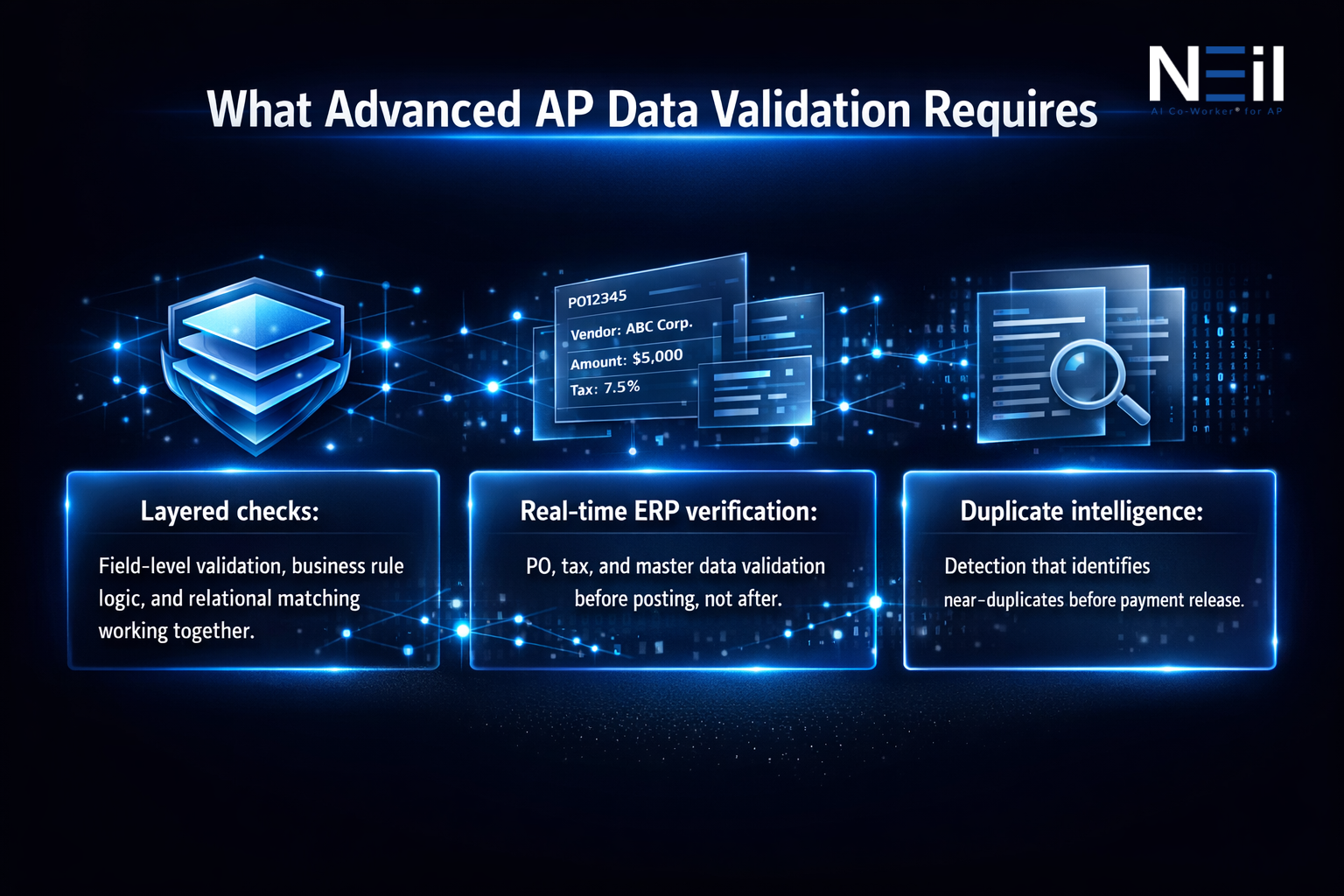
The first line of defense is field-level validation: ensuring that each data element extracted from an invoice is present, correctly formatted, and within acceptable value ranges. This layer leverages pattern-matching constructs — most commonly regular expressions (regex) — to enforce structural rules without any business context.
Practical examples include validating that invoice numbers follow a defined alphanumeric pattern (e.g., INV-YYYY-NNNNN), confirming that dates are genuine calendar dates in the expected format, verifying that vendor tax identification numbers match the jurisdiction’s schema, and ensuring monetary amounts contain only numeric characters and a decimal separator. Field-level validation is fast, deterministic, and catches the broadest category of data entry errors before they enter downstream logic.
Business Rules & Record Relationship Validation
Beyond format checks, advanced data validation in AP requires evaluating the semantic correctness of an invoice — does the data make business sense? This is where business rule validation operates.
Business rule checks verify that invoice totals equal the sum of line items plus applicable taxes; that tax rates applied match the vendor’s jurisdiction and the product or service category; that PO numbers reference open, unfulfilled purchase orders with sufficient remaining value; that the invoiced quantity and unit price produce the extended line amount; and that payment terms match those negotiated in the vendor master record.
These relational checks are particularly powerful for AP process data quality because they catch errors that are individually well-formatted but collectively incorrect.
Duplicate Detection with Pattern Matching
Duplicate invoices represent one of the most financially damaging failure modes in AP. Even a small overpayment rate across thousands of monthly invoices creates material losses. Advanced duplicate detection goes beyond simple exact-match comparison (same invoice number from same vendor) to fuzzy pattern matching that identifies near-duplicates — invoices with slightly different reference numbers, dates shifted by a day or two, or amounts differing by a rounding amount.
Effective duplicate detection compares combinations of vendor ID, invoice number, invoice date, invoice amount, and PO reference using configurable similarity thresholds. Invoices that exceed a similarity score are flagged for human review before payment, not after. The result: overpayments are caught at the gate rather than recovered through laborious vendor reconciliation months later.
How Does Neil Implements These Validation Techniques?
Data Extraction & Pre-Validation
Neil’s validation pipeline begins the moment an invoice arrives, whether submitted via email, supplier portal, EDI feed, or scanned document. Using a combination of Intelligent Character Recognition (ICR), NLP, and structured data extraction models, Neil captures all relevant invoice fields and normalizes them into a consistent internal format.
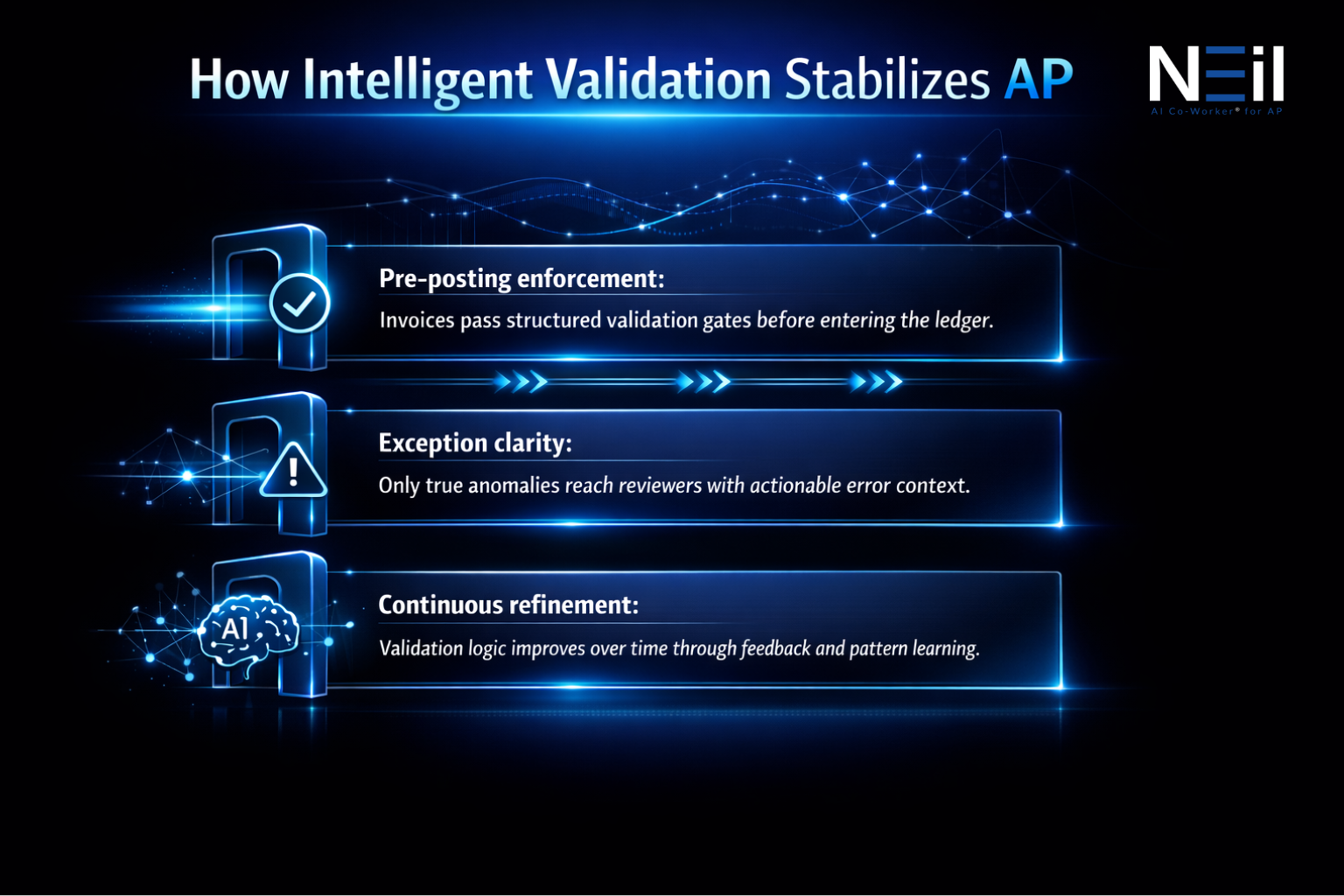
Pre-validation runs immediately: Neil checks that all mandatory fields are present, applies regex format validations to each extracted field, and flags any extraction-confidence issues where the underlying document quality may have introduced errors. Invoices that fail pre-validation are immediately returned to the supplier or routed to an exception queue with specific, actionable error messages — rather than silently passing incomplete data into the workflow.
Intelligent Validation Workflow
Once pre-validation passes, Neil applies its layered intelligent validation workflow. Business rule checks execute against the organization’s ERP and procurement data in real time: PO matching verifies that the invoice references a valid, open PO with sufficient remaining value; three-way matching confirms alignment between the PO, goods receipt, and invoice; tax validation checks applicable rates against the vendor’s jurisdiction and commodity codes.
Reducing Manual Intervention
By resolving format errors, duplicate risks, and business rule violations automatically, and by providing actionable exception information for the invoices that do require review, Neil compresses exception handling time and allows AP staff to focus on genuinely complex cases rather than routine error correction.
Organizations deploying Neil have reported invoice straight-through processing rates increasing significantly, with exception queues shrinking and payment cycle times compressing from weeks to days. The reduction in manual effort is not merely a productivity gain: it is also a risk reduction, as automated, consistent validation is inherently less prone to the variability and fatigue that affect manual review.
Conclusion
Invoice data validation is not a peripheral concern for AP teams — it is the operational foundation on which invoice accuracy, financial control, and risk management are built. As invoice volumes grow and finance teams face pressure to do more with less, the gap between organizations with sophisticated AP data validation techniques and those relying on manual review will only widen.
The advanced techniques covered in this guide, field-level format validation, business rule and relationship checking, pattern-based duplicate detection, and ML-powered anomaly detection represent the current state of the art in how to validate invoice data in accounts payable. Together, they form a comprehensive defense against the errors, frauds, and inefficiencies that drain AP performance.
Neil AI brings these techniques together in a single, intelligent platform designed for the realities of modern AP operations. By combining automated extraction, multi-layer validation, and continuous learning, Neil enables finance teams to achieve higher accuracy, faster cycle times, and lower processing costs — while freeing AP professionals to focus on the work that actually requires their expertise.
For organizations serious about AP process data quality and long-term financial efficiency, investing in intelligent validation is not optional. It is the foundation of everything that follows.
Frequently Asked Questions (FAQs)
Invoice data validation is the process of checking invoice details (vendor, amount, date, PO, tax) to ensure they are accurate, complete, and follow company rules before payment is made.
AP data validation is critical because it prevents duplicate payments, overpayments, fraud, compliance issues, and delays. Thus, reduces manual rework, shortens payment cycle times, and protects the organization against financial and regulatory risk.
Advanced validation combines:
- Advanced validation combines:
- Field-level checks (format, missing data)
- Business rule validation (PO matching, tax checks)
- Fuzzy duplicate detection
- Machine learning anomaly detection
The best way to detect duplicate invoices is through fuzzy pattern matching that checks multiple fields simultaneously. This approach catches near-duplicate invoices that exact-match logic would miss, preventing overpayments before they occur.
Neil AI supports AP data validation through a multi-layer intelligent workflow: automated data extraction and normalization, field-level format checks, real-time business rule validation against ERP and procurement data, ML-powered anomaly detection, and continuous learning from exception feedback. Neil flags invalid invoices early, provides actionable exception information for reviewers, and improves its validation accuracy over time.
Automated validation reduces manual workload by resolving the majority of data quality issues like formatting errors, missing fields, duplicate flags, and business rule violations without human intervention. It only sends real exceptions to AP teams, reducing manual effort by 60–80% in mature systems.