Finance functions have long operated under the weight of legacy processes whether it’s paper invoices, manual data entry, siloed approval chains, and reactive reporting. As businesses’ scale and financial complexity grow, these outdated ways of working are no longer sustainable. Accounts payable transformation is how leading organizations break free from these constraints and rebuild their AP function from the ground up.
Accounts payable transformation is more than just adopting new software. It is a fundamental rethinking of how AP operates—redesigning processes, upskilling teams, integrating intelligent technologies, and aligning the AP function with broader strategic finance goals. The result is a faster, smarter, and more resilient AP operation that creates measurable value across the organization.
This guide explains what accounts payable transformation means, why it matters, what it involves, and how your organization can lead a successful AP transformation journey.
What Is Accounts Payable Transformation?
Accounts payable transformation is the strategic overhaul of an organization’s AP function, encompassing process redesign, technology adoption, organizational change, and performance improvement. It goes beyond incremental efficiency gains to fundamentally change how the AP team captures, processes, approves, and pays invoices, and how it contributes to financial strategy.
A true AP transformation initiative typically combines intelligent automation, AI-powered data processing, ERP integration, and cultural change to eliminate manual work, reduce costs, and give finance leaders real-time visibility into cash flow and liabilities.
Where traditional Accounts payable improvement efforts focus on doing the same things faster, AP transformation focuses on doing things differently — replacing manual steps with intelligent workflows, reactive decision-making with predictive analytics, and fragmented systems with connected, end-to-end processes.
Why Accounts Payable Transformation Is a Business Imperative?
AP sits at the center of an organization’s financial operations, governing supplier payments, cash flow obligations, and financial record accuracy. When it works well, it supports strong vendor relationships, precise forecasting, and strategic cash management. When it doesn’t, the consequences ripple across the entire business.
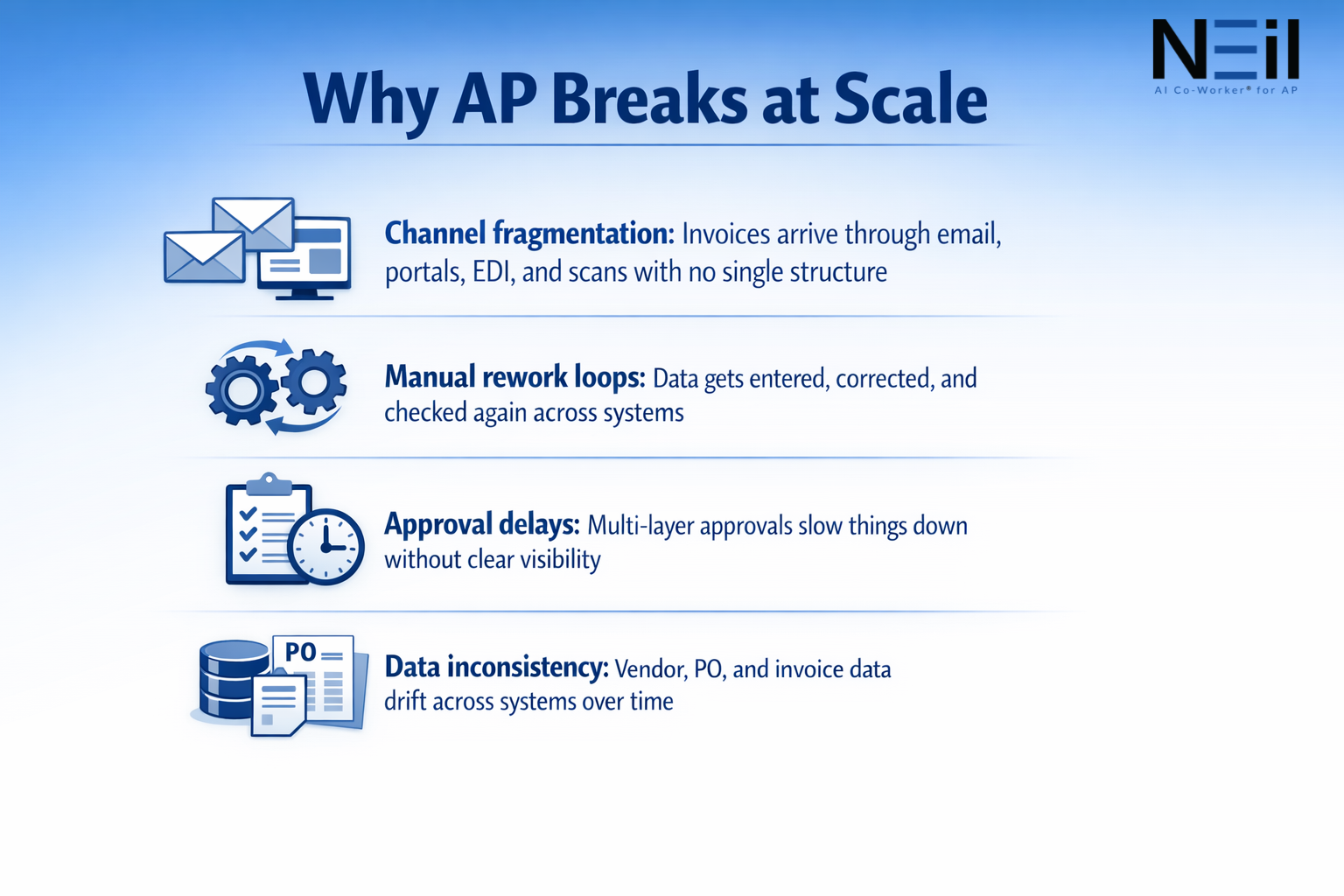
Most AP functions face four major challenges:
Risk of Fraud and Errors
Manual AP processes create multiple points of failure. Duplicate invoice submissions, unauthorized vendor setups, and data entry mistakes are difficult to catch without systematic controls. Fraudulent invoices can slip through undetected for months. AP transformation introduces the automated checks, anomaly detection, and audit trails needed to protect the organization.
Inefficient Data Handling
AP teams receive invoices across email, paper, portals, and EDI feeds, each requiring different handling. Without a unified data capture and processing layer, teams spend hours re-keying information, correcting errors, and tracking down missing details. AP transformation replaces this fragmented approach with intelligent, centralized data ingestion that handles any format with consistent accuracy.
Lack of Real-Time Financial Visibility
When AP runs on manual processes and disconnected systems, finance leaders cannot get a timely or accurate picture of outstanding liabilities, approval bottlenecks, or payment schedules. Cash flow forecasting becomes guesswork. AP transformation integrates data across systems and delivers real-time dashboards that turn AP from a black box into a source of financial intelligence.
How Accounts Payable Transformation Works?
AP transformation unfolds across five interconnected dimensions, each addressing a different layer of how the AP function operates:
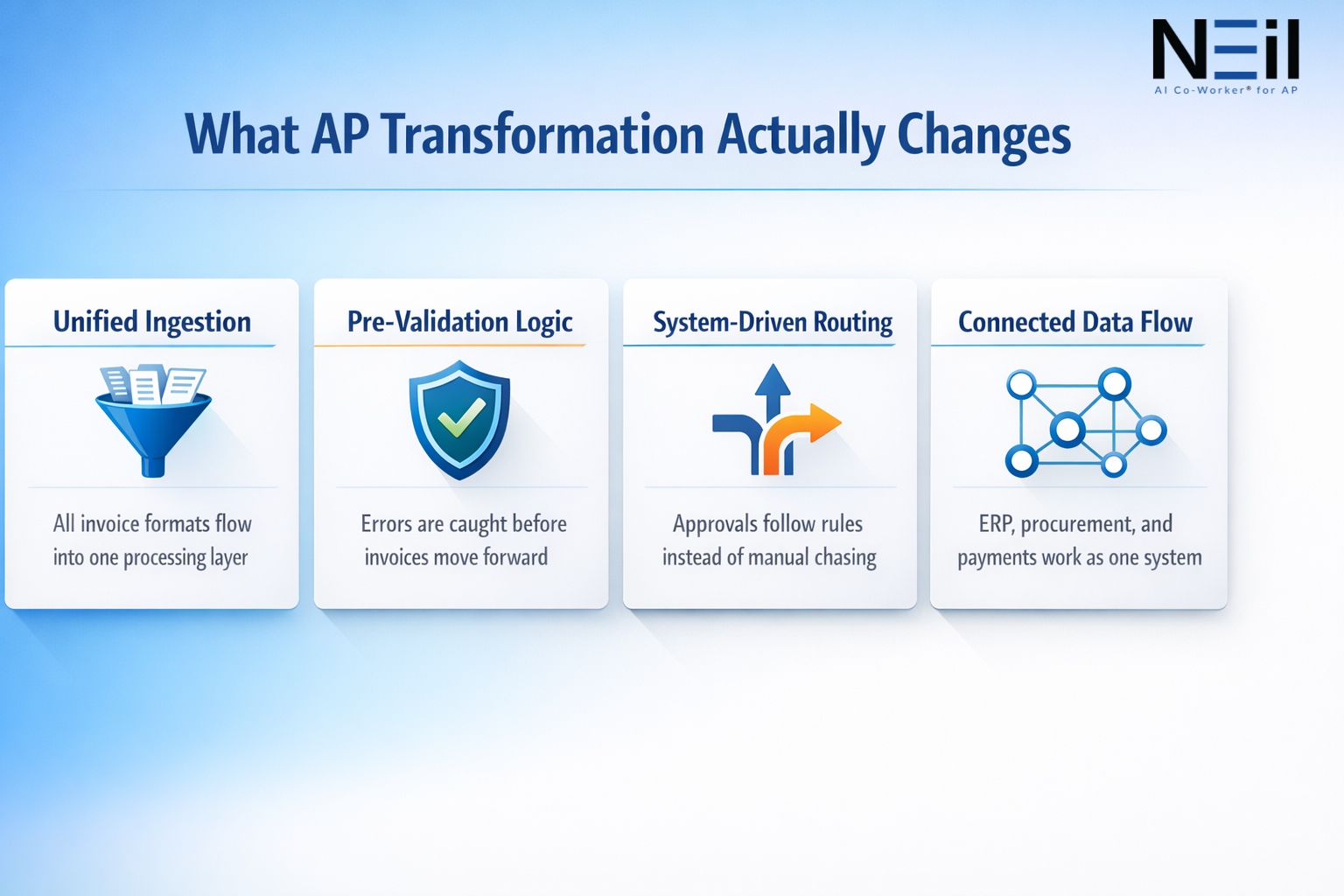
- Process Redesign: Existing workflows are mapped, redundant steps eliminated, and approval hierarchies rationalized. The goal is a lean, logical process architecture before any technology is layered on top.
- Intelligent Invoice Processing: AI-powered capture and extraction automatically reads invoices in any format, pulls key data fields, and validates them against purchase orders, contracts, and goods receipts — replacing manual entry entirely.
- Automated Approval Routing: Rules-based workflows route invoices to the right approvers based on amount, cost center, or vendor — with built-in escalation paths and deadline reminders to prevent bottlenecks.
- ERP and Systems Integration: The AP platform connects bi-directionally with ERP, procurement, and treasury systems, creating a single source of truth for financial data and eliminating manual handoffs.
- Continuous Performance Management: Real-time dashboards track AP KPIs — cycle times, exception rates, cost-per-invoice, and on-time payment performance — enabling ongoing refinement rather than reactive firefighting.
What are the Key Capabilities to Look for in Accounts Payable Transformation?
A successful AP transformation is built on a foundation of powerful, integrated capabilities. When evaluating an AP transformation solution, look for:
- Automated Invoice Capture: Unified ingestion of invoices from any channel — email, portal, EDI, or paper scan — with no manual sorting required.
- AI-Powered Data Extraction: Machine learning models that accurately extract invoice fields, classify documents, and continuously improve with every transaction processed.
- 2-Way, 3-Way, and N-Way Matching: Automated validation of invoices against purchase orders, delivery confirmations, and contracts to prevent overpayment and fraud.
- Configurable Approval Workflows: Rules-based routing that adapts to your organizational structure, with mobile-friendly approvals and automated escalations.
- Real-Time Analytics and Reporting: Executive dashboards and granular AP reports that provide instant visibility into liabilities, processing performance, and cash flow impact.
What are the Benefits of Accounts Payable Transformation?
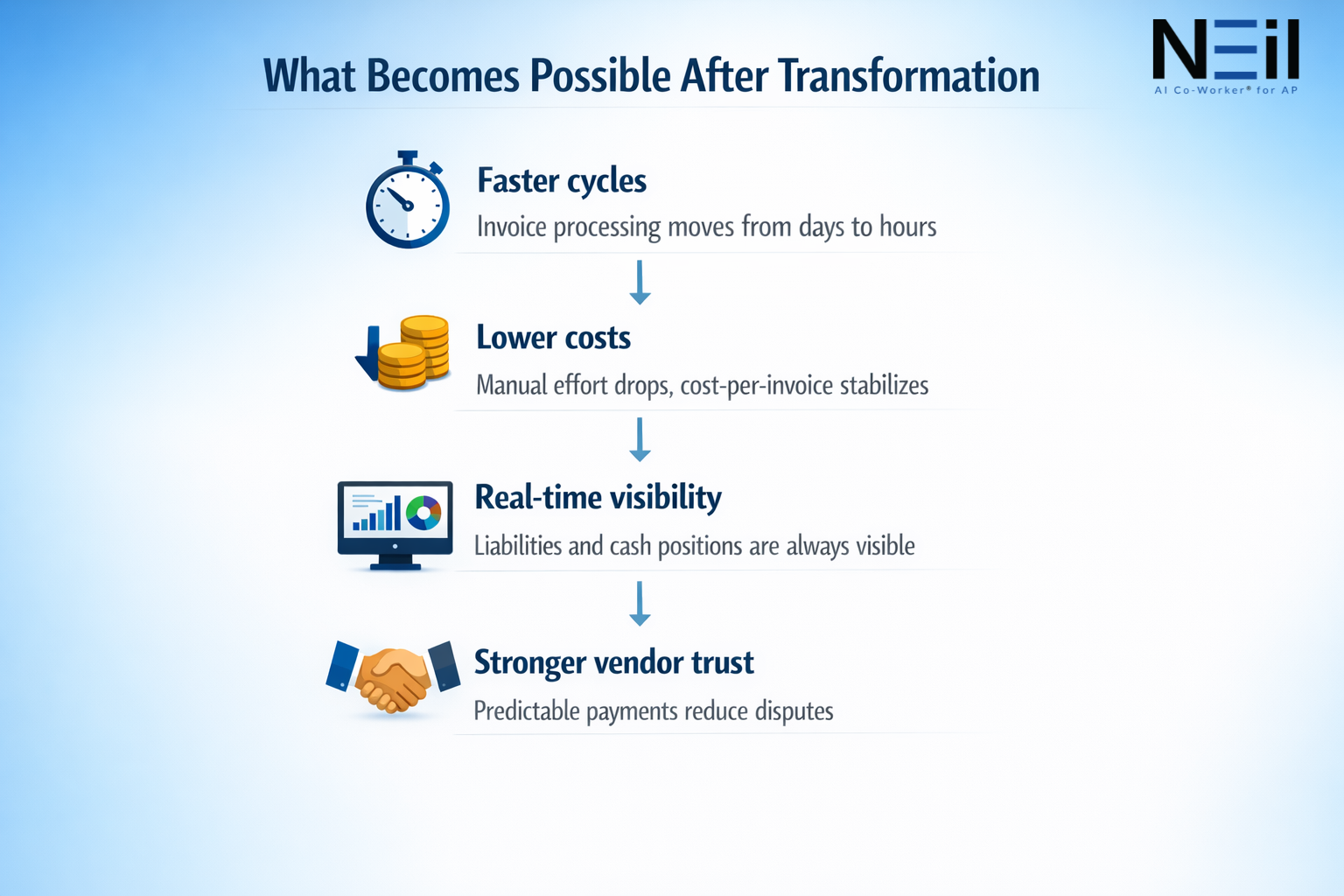
When AP transformation is executed well, the impact is felt across finance, operations, and vendor relationships. Here’s what organizations can expect.
Faster Invoice Processing
Transformed AP functions process invoices in hours rather than days or weeks. Faster invoice processing cycle times allow organizations to capture early payment discounts, meet supplier payment terms consistently, and respond more nimbly to changes in cash flow requirements.
Reduced Operational Costs
AP transformation dramatically reduces the cost-per-invoice by automating high-volume, low-value processing tasks. Organizations can scale invoice volumes without adding headcount, and AP staff can be redeployed to higher-value activities such as spend analysis, vendor management, and strategic planning.
Stronger Vendor Relationships
Consistent, on-time payments and transparent invoice status communication build trust with suppliers. A transformed AP function reduces payment disputes, minimizes vendor queries, and creates the foundation for preferred supplier arrangements and favorable payment terms.
Better Financial Visibility
Perhaps the most strategically significant benefit of AP transformation is the shift from lagging, fragmented reporting to real-time financial intelligence. Finance leaders gain an accurate, current view of outstanding liabilities, payment schedules, and AP performance — enabling more confident decisions about cash deployment, borrowing, and financial planning.
How to Implement an Accounts Payable Transformation?
A successful AP transformation requires deliberate planning, strong sponsorship, and a phased execution approach. Follow these steps to build a transformation that delivers lasting results:
- Evaluate Current AP Processes: Conduct a thorough assessment of your existing workflows, systems, and performance data. Identify bottlenecks, error rates, and cost drivers that will anchor your business case for transformation.
- Define the Transformation Vision: Articulate what success looks like — in terms of processing speed, cost reduction, accuracy, and strategic capability. Align finance leadership and key stakeholders around a shared transformation roadmap.
- Choose the Right AP Transformation Solution: Evaluate technology partners based on AI maturity, ERP integration capability, scalability, compliance support, and the depth of change management they provide alongside the platform, and then select the right AP automation solution.
- Integrate with ERP and Core Systems: Ensure your AP transformation platform connects bi-directionally with your ERP, procurement system, and treasury tools to create a single source of truth for financial data.
- Engage and Train Finance Teams: Transformation is as much about people as technology. Invest in change management, provide role-specific training, and communicate the benefits clearly so teams embrace the new ways of working.
- Monitor, Measure, and Optimize: Use analytics to track transformation KPIs from day one. Hold regular reviews to assess progress against targets and continuously refine workflows, approval structures, and exception-handling processes.
What is the Future of Accounts Payable Transformation?
AP transformation is a continuously evolving capability. The role of AI in AP is expanding well beyond invoice capture and matching: organizations are now using it to analyze spend patterns, predict cash flow impacts, and surface compliance risks proactively. The near-term target state for most transformed AP functions is fully touchless processing, where invoices move from receipt to payment with zero manual handling, enabled by AI systems that continuously learn and improve. Further ahead, AP transformation is converging with broader finance transformation, autonomous finance operations where AI coworkers manage routine processes end-to-end and human teams focus entirely on judgment, strategy, and exception resolution.
For organizations that act now, the opportunity is significant. AP transformation delivers lower costs, faster processing, stronger vendor partnerships, and the real-time financial intelligence that modern finance leaders need. More strategically, it lays the foundation for a finance function that can scale without friction, adapt to changing business conditions, and contribute meaningfully to competitive advantage — not just operational efficiency
How Neil, Our AI Coworker for AP, Accelerates Your Transformation?
Neil, our AI co-worker for AP is built specifically to power accounts payable transformation. Rather than layering automation on top of broken processes, Neil helps finance teams reimagine their AP function from the ground up by combining intelligent invoice processing, automated workflows, and real-time analytics into a single, purpose-built platform.
With Neil, your AP transformation delivers:
- End-to-end AP process transformation — from invoice capture to ERP posting — with minimal manual intervention
- AI-powered data extraction that handles any invoice format, language, or structure
- Intelligent multi-way matching with real-time discrepancy flagging and resolution guidance
- Seamless ERP integration for unified financial visibility across systems
- Continuous learning capabilities that improve processing accuracy and workflow efficiency over time
Ready to start your accounts payable transformation? Book a demo with Neil today and discover how your finance team can lead a transformation that delivers measurable, lasting value.
Frequently Asked Questions (FAQ)
Accounts payable transformation is the strategic improvement of the AP function using process redesign, automation, and technology to make invoice processing faster, more efficient, and data-driven.
It works by redesigning AP workflows, implementing automation and AI for invoice processing, integrating with ERP systems, and using analytics to monitor and improve performance.
Key benefits include faster invoice processing, improved accuracy, lower operational costs, better vendor relationships, and improved cash flow visibility.
AP automation focuses on automating specific tasks, while AP transformation is a broader strategy that improves processes, technology, and the overall AP function.
Businesses should look for AI-powered invoice capture, automated workflows, ERP integration, real-time analytics, compliance features, and scalable automation tools.